You've got a long, thin cut on your last ball. You'd make it maybe one time in three. You know a safety is on. You go for it anyway, it rattles, and your opponent walks to the table and runs out.
Then you sit in your chair and think "I should have played safe." You knew it before you shot. You'll do it again next week.
If that sounds familiar, you're in good company. Of the 2,838 players who completed our full assessment, 22% said their usual shot-choice mistake is going for risky pots when they should play safe. That makes it one of the three most common faults in our data study. This article gives you a simple rule for the decision, three safeties you can learn this month, and a drill to make them reliable.
What the data shows
The numbers come from players' own answers, so they're self-reported. That's useful here: a player who admits "I go for risky pots" already knows something is wrong.
22% go for risky pots when they should play safe. That's out of 2,838 players who completed the full assessment, mostly US league players.
Experience barely touches it. Among players in their first year, 26% gave that answer. Among players with more than 15 years at the table, it was still 20%. Most faults in our data drop sharply with experience. This one hardly moves.
Safety is the skill players trust least. We asked 4,947 players (everyone who did the full assessment or the free quiz) to rate nine skills from 1 to 10. Safety came last: only 21% rate their safety 8 or higher, and 24% rate it 3 or lower. Compare that with the bridge hand, which 57% rate 8 or higher.
15% rarely or never weigh up their options when snookered. Again out of the 2,838. They hit and hope.
Put those together and you get a clear picture. Players don't trust their safeties, so they don't play them, so they never get good at them, so they keep not trusting them. Years of play don't break that loop on their own.
Why it happens
I see four reasons over and over in the players I coach.
Potting feels like progress, safety feels like giving up. When you pot a ball, something happens. When you play safe, you hand the table over on purpose. It feels passive, even a little cowardly, especially in a league match with your team watching. That feeling has nothing to do with the percentages, but it drives the decision.
Nobody gave them a rule. Most players decide shot or safe in the moment, on feel. Feel is fine when you're fresh and relaxed. In the fifth game of a tight match, feel turns into hope.
They only count the make. A player looking at a 35% cut thinks about the time it goes in. They don't picture the other 65%, where the object ball stops in the jaws and the cue ball sits in the middle of the table. The cost of a miss is the part that decides racks, and it's the part they leave out.
They never practise safeties. Look at how most people practise: they pot balls, or they play frames. Of the 2,838 players, 36% spend most of their practice time playing frames. In my coaching, very few players have ever set up a safety and practised it on purpose. So when a safety comes up in a match, it's a shot they've barely hit. Of course they don't trust it.
The last one is the root. You can't choose a safety confidently if you can't play one reliably. Fix the skill and the decision gets much easier.
How to fix it
There are two parts: a rule for the decision, and a small set of safeties you can actually play.
A simple shot-or-safe rule
Before any shot you're unsure about, ask yourself two questions, and answer honestly.
1. Out of 10 attempts, how many would I make? Not your best day. An average Tuesday night.
2. If I miss, what does my opponent get? An open table, or something awkward?
Then use this rule of thumb. It's how I teach it, not a law of the game:
- 7 or more out of 10: go for it.
- 5 or 6 out of 10: go for it only if a miss leaves your opponent little or nothing. Otherwise, play safe.
- 4 or fewer out of 10: play safe, unless the safety is even harder than the pot.
The second question is what most players skip. A 50% pot where a miss leaves the cue ball tucked up on the rail is a fine shot. A 50% pot where a miss leaves your opponent ball-on in the middle of the table is a bad one. Same pot, different decision.
There's also a third option that good players use constantly: the two-way shot. You attempt the pot, but you play it at a pace and line where a miss leaves your opponent in trouble. You're not giving up the pot. You're insuring it. When you're torn between shot and safe, look for the two-way shot first.
Three safeties every league player can learn
You don't need a repertoire of 30 safeties. Three will cover most of what comes up in league play.
1. Hide behind a ball. Play the object ball softly to a spot where a blocker sits between it and where your cue ball will stop. This is the classic snooker, and it's the one that wins the most racks at club level.
2. Distance. Send the object ball to one end of the table and leave the cue ball at the other, ideally close to a rail. Your opponent faces a long shot off an awkward bridge. Even if they can see the ball, they rarely have a good pot.
3. Kill the angle. Play a thin hit that sends the object ball onto a rail and leaves the cue ball with no straight line to a pocket. This is the easiest to learn because it only needs pace control, not perfect position.
One rules reminder, because it costs players racks: under WPA, CSI and APA rules, after the cue ball hits your ball, at least one ball has to reach a rail or go in a pocket. A safety that stops dead in the middle of the table without touching a rail is a foul, and gives away ball in hand. I've covered that rule in the 9-ball scratch and foul rules.
All three safeties depend on one thing: being able to send the cue ball a set distance. If your speed is guesswork, your safeties will be too. That's worth working on separately, and cue ball control is the place to start.
The drill: three-position safety drill
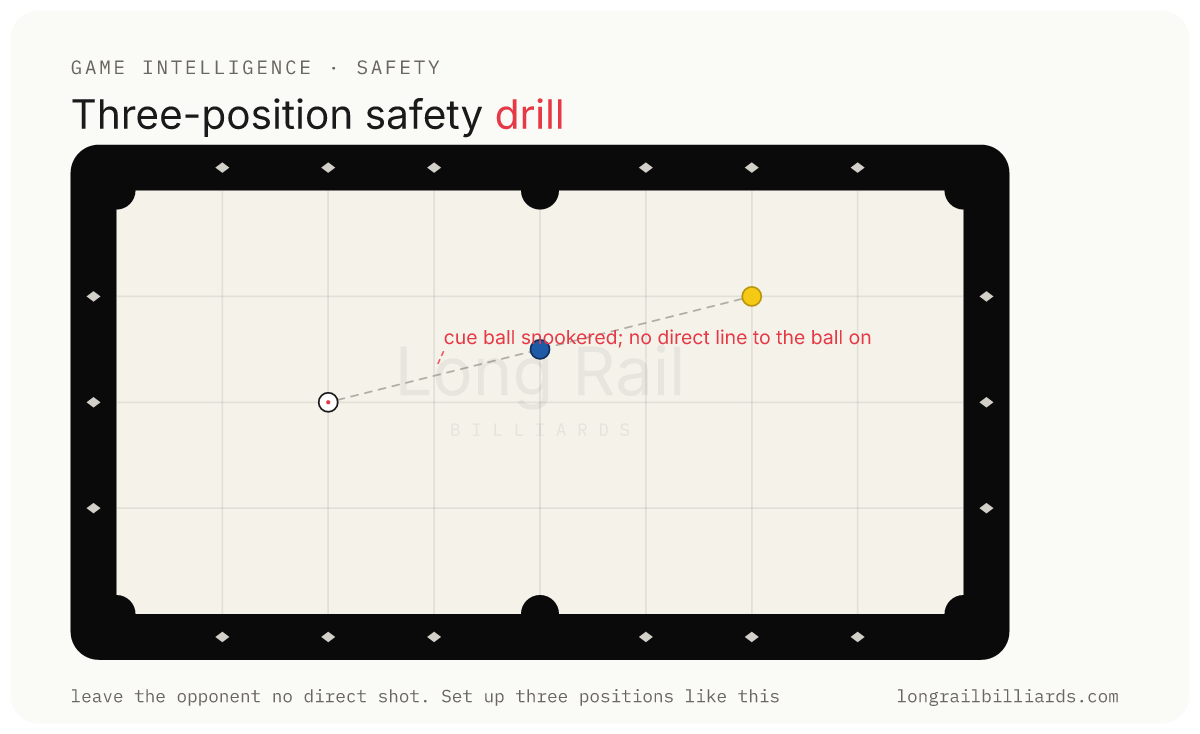
This is the drill I give players whose report flags safety play. It turns safeties from a guess into a skill you can score.
Setup: set up three awkward object ball positions on an empty table:
- a ball near a pocket but with no clear pot,
- a ball in the middle of the table with your cue ball blocked,
- a ball sitting on a cushion.
How: from each position, play one safety. Score each shot:
- 3 points: perfect snooker. Your opponent can't see the ball.
- 2 points: no easy pot.
- 1 point: they have a clear shot, but it's awkward.
- 0 points: you've sold them the table.
Goal: play five rounds of the three positions, 15 shots in all. Your score per round is out of 9.
Target: an average of 6 or more out of 9 per round.
If you score under 4 per round, don't worry about it. That's normal for a player who has never practised safeties, and it's exactly why they've been avoiding them in matches. Twice a week for a month usually changes that.
How to know it's working
Three things to watch.
Your drill score. Write down your average out of 9 every time you run the drill. You want a line that climbs toward 6 and stays there. If it's flat after three weeks, film a round and look at your pace: most failed safeties go too far.
Your decision log. For one week of matches, after every frame you lose, write one line: was the mistake the wrong shot, or the right shot played badly? This is the decision audit I use in the report. If most of your losses are "wrong shot", the rule above is where your work is. If most are "right shot, bad execution", your decisions are fine and the problem is technique.
What your safeties do in matches. Count how many safeties you play in a match, and how many of them lead to your opponent fouling, missing, or leaving you a shot. You don't need a precise number. You want to see that count go up, and to notice that you're choosing the safety without the old feeling of giving up.
The real sign it's working is quieter: you stop having that conversation with yourself in the chair after the rack.
Common questions
When should you play a safety in pool?
Play a safety when the pot is less likely to win you the rack than the safety is. As a rule of thumb, if you'd make the shot fewer than 5 times out of 10, or a miss would leave your opponent an easy table, play safe.
How do you play a safety in pool?
Pick a target spot for the object ball and the cue ball before you shoot, and play softly enough to control both. The three easiest safeties to learn are hiding the cue ball behind another ball, leaving the balls at opposite ends of the table, and a thin hit that kills your opponent's angle.
Is playing safe in pool bad sportsmanship?
No. Safety play is a legal and normal part of every pool game. The APA's own team manual lists a safety as an ethical defensive shot, and no rulebook treats it as anything else.
Why do I keep going for shots I should play safe on?
Usually because you don't trust your safeties, so the pot feels like the safer choice. Practising a few safeties until you can score them reliably makes the decision much easier in matches.
What is a two-way shot in pool?
A two-way shot is a pot attempt played so that a miss still leaves your opponent in trouble. It's often the best answer when you can't decide between going for the shot and playing safe.
Do you have to hit a rail on a safety?
Yes, under WPA, CSI and APA rules, after the cue ball contacts your object ball, a ball must reach a rail or be pocketed. If not, it's a foul and your opponent gets ball in hand.
Related
- What 2,838 pool players get wrong: our data
- How to win at 9-ball: safety play and the push out in 9-ball strategy
- The three-foul rule in 9-ball: how good safeties can win a rack outright
Find out if this is one of the things costing you frames. Take the free assessment.
A 12-question read of your stance, stroke, cue ball and head. You'll find out which of the eight player types you are, and where the real bottleneck in your game is. Free, no signup.
Take the player read