You put the hours in. You go down to the club on your own, hit balls for an hour or two, and leave feeling like you've worked. And a month later you play exactly the same as you did before.
That's the most common story I hear from players, and the data shows why. Of 2,838 players who completed our full assessment, 74% don't measure their practice at all. Only 3% keep a practice log with targets. Almost everyone is practising, and almost nobody knows whether it's working. You can see the full data study here.
Practice that isn't measured isn't really practice. It's playing on your own. This article is about how to turn it into something that moves your game.
What the data shows
These are self-reported answers, so they're what players say about their own habits.
Experience doesn't fix it. Among first-year players, 85% don't measure their practice. Among everyone with more experience, it's still 72% to 76%. Even among the 202 players who mainly compete in tournaments, 62% don't measure.
Structure is missing too. 26% say their practice is random ("I just hit balls around") and 13% don't practise at all, they only play matches. That's 39% with no structure.
Most practice time goes on frames. 36% spend most of their practice time playing frames, against themselves or others.
The basics get skipped. 22% have never spent 30 minutes working only on basics, with no games.
It isn't a time problem, either. 31% play or practise 7 or more hours a week. And the share who put in 7 or more hours is about the same at every experience level, 30% to 33%. Plenty of players have the hours. The hours just aren't aimed at anything.
Why it happens
Playing frames feels like practice
Frames are fun, they're competitive, and they use every skill at once. But in a frame you get one go at each shot, in a random order, with no repetition and no feedback beyond "made it" or "missed it". If your draw shot is unreliable, a frame might give you two draw shots in an hour. That's not enough repetitions to change anything.
Frames are where you test your game. They're not where you build it.
Without a number, your memory lies
After a session, players remember the great shots and forget the routine misses. So every session feels a bit better than it was. Without a number written down, you can't tell a good week from a bad one, and you can't tell whether a change you made helped.
I see this constantly. A player is sure their stop shot has improved. We measure it, and it's exactly where it was a month ago. The feeling was real. The progress wasn't.
Nobody has told them what to aim for
Most players have never been given a target. "Practise your stop shot" means nothing. "Stop the cue ball dead from 24 inches, four times out of five" means something. You can hit it or miss it, and you know which.
Basics are boring
Thirty minutes of straight pots and stop shots is dull compared to a frame. So it gets skipped. But the basics are where most faults live. A stroke that isn't straight shows up in every part of your game, and you'll only see it clearly on a simple, repeated shot. That's what drills like the straight-line stroke test are for.
How to fix it
The fix has three parts: a target for every drill, a structure for every session, and a log that keeps you honest.
1. Pick one thing to work on. One. The thing that costs you the most frames right now. If you don't know what that is, finding your real fault comes first, because practising the wrong thing well still doesn't help.
2. Give every drill a score and a target. Every drill you do should end with a number: 7 out of 10, 18 out of 25, 4 out of 5 at every distance. Write the target down before you start.
3. Split a 60-minute session like this. This is the structure I give most players:
- 10 minutes: warm-up. Straight pots and a few stop shots at a fixed distance. Get the stroke going and the eyes in.
- 15 minutes: your benchmark drill. The same scored drill every week (more on that below). This is your progress line.
- 25 minutes: your focus drill. The one skill you picked in step 1, with a score.
- 10 minutes: pressure frame or game. Now play, but with something on it: run three balls in a row before you can stop, or replay any shot you miss.
If you only have 30 minutes, keep the benchmark and the focus drill, and halve both.
4. Keep the frames, but put them last. Playing frames isn't bad. It's just not the whole session. Use them at the end, to test what you worked on.
The drill: a weekly benchmark
A benchmark is one drill you do every week, scored the same way, so you have a single number that shows whether your game is moving. It should test something fundamental. I use the stop shot distance ladder from the Long Rail Report, because a stop shot exposes your stroke, your contact and your speed all at once.
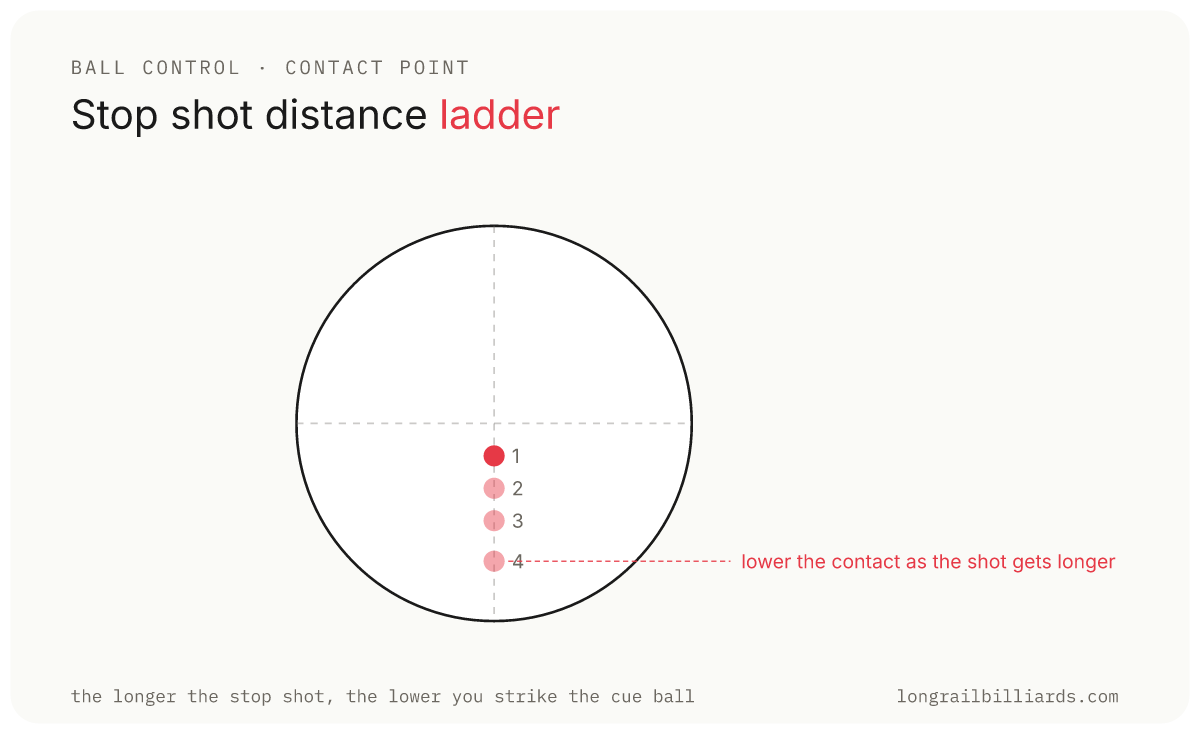
Setup: cue ball and object ball in a straight line to a corner pocket. Start with 12 inches between the balls, then 18, 24, 36 and 48 inches.
How: pot the object ball and make the cue ball stop dead. Hit lower on the cue ball as the distance grows: just below centre at 12 inches, lower at 24, lower still at 36, clearly low at 48. Five shots at each distance, 25 shots in all.
Goal: record how many dead stops you get at each distance, and the total out of 25.
Target: 4 out of 5 dead stops at every distance up to 36 inches. Write down which contact height worked at each distance, too.
Do it at the start of your session, after warming up, on the same day each week if you can. Don't practise it in between. It's a measurement, not your training.
The practice log
Your log can be a notebook, a note on your phone or a spreadsheet. Keep it to one page per week, with five things on it:
- Date and minutes practised.
- Benchmark score (out of 25), and the breakdown by distance.
- Focus skill and its drill score for each session.
- One line on what you noticed: "draw better when I slowed the backswing", "missed left all night".
- Match result and one thing that cost you a frame, if you played that week.
That's it. It should take two minutes at the end of a session. The point isn't the paperwork. It's having a number you can compare with last week.
How to know it's working
Look at your log every four weeks and ask three questions.
Has the benchmark moved? If your stop shot ladder has gone from 14 to 18 out of 25, your stroke is getting better, whatever it feels like. If it hasn't moved in a month, something about your practice needs to change: the drill, the focus, or how you're doing it.
Has the focus drill score reached its target? When it has, hold it for two more weeks to make it stick, then pick the next thing.
Does it show up in matches? The match line in your log is where this pays off. If the thing that cost you frames a month ago has stopped appearing, your practice is doing its job.
One warning: progress isn't a straight line. A bad week isn't a failure. Four weeks of no change is the signal to look at.
Common questions
How should I practise pool alone?
Practise one skill at a time with a scored drill, not by playing frames against yourself. Start with a 10-minute warm-up, do a benchmark drill you repeat weekly, then spend most of the session on the one skill costing you the most. Write every score down.
How long should a pool practice session be?
Around 60 minutes is enough for most players, if it's structured. A focused hour with targets beats three hours of hitting balls around. If you only have 30 minutes, do your benchmark and one focus drill.
How do I track pool practice?
Keep a simple log: date, minutes, your benchmark score, your focus drill score and one note on what you noticed. Use the same scored drills every time so the numbers are comparable. Review it every four weeks.
Is playing frames good practice?
Playing frames is good for testing your game, not for building it. A frame gives you too few repetitions of any one shot to change it. Put frames at the end of a session, after your drills.
How often should I practise basics?
Every session should include some, even if it's only the warm-up. Straight pots and stop shots at fixed distances show you whether your stroke is sound, and they're where most faults show up first. A full 30-minute basics session once a week is a good habit.
Why am I not improving even though I practise a lot?
Usually because the practice has no target and no measurement, so you can't see what's working. Pick one weakness, give it a scored drill with a target, and track it weekly. If the number doesn't move in a month, change the drill or the focus.
Related
- What 2,838 pool players get wrong: our data
- Pool practice drills: a coach's structured routine
- How to get better at pool: a coach's honest guide
Find out if this is one of the things costing you frames. Take the free assessment.
A 12-question read of your stance, stroke, cue ball and head. You'll find out which of the eight player types you are, and where the real bottleneck in your game is. Free, no signup.
Take the player read