More 9-ball arguments start on the break than anywhere else. Was that legal? Does the 9 count? Who breaks again?
The trouble is that the answers depend on which rulebook you're under, and most players don't know there's more than one. So here are the break rules from the three that matter: the WPA rules (the world standard), CSI rules (used by BCA leagues), and the APA's rules. Where they agree, I'll say so once. Where they differ, I'll show you how.
If you want the technique side, where to put the cue ball and how hard to hit, that's in how to break in 9-ball. This piece is the rules.
The rack comes first
Every rulebook racks nine balls in a diamond, with the 1-ball at the front and the 9-ball in the middle. The other seven go in at random.
Where the diamond sits is the one thing that differs. Under current WPA rules, the 9-ball sits on the foot spot. Under CSI rules and APA rules, the 1-ball sits on the foot spot. That moves the whole rack back by two rows, and it changes how the break behaves. If you play both, notice which one you're under.
The WPA's playing regulations also say the balls should be placed randomly, and a player who keeps arranging them on purpose can be warned and then penalised. In the APA, the non-breaking player racks, and the breaker can ask for a re-rack. There's more on getting it tight in how to rack 9-ball.
What makes a break legal
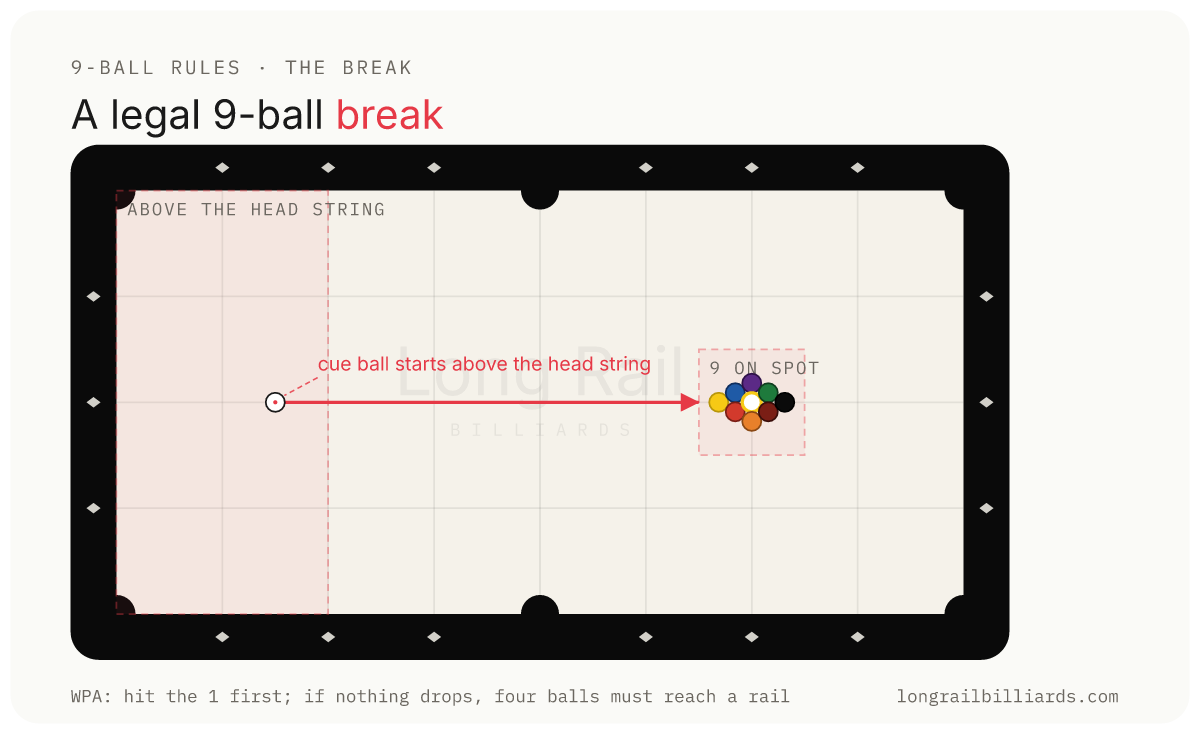
Under WPA rules:
- The cue ball starts in hand above the head string, the line across the table at the second diamond from the head rail.
- The cue ball must hit the 1-ball first, the same as every shot in 9-ball.
- If no ball is pocketed, at least four object balls must be driven to a rail. If not, it's a foul.
CSI rules say the same, and spell out that the cue ball must hit the 1 before any other ball or cushion.
The APA keeps the four-balls-or-a-pocketed-ball requirement and adds that the cue ball may not be shot into a rail before it hits the rack. But on the 1-ball, it's more relaxed: failing to hit the 1 first on the break is not a foul in the APA.
The WPA three-ball rule
At WPA ranking 9-ball events there's an extra test, the three-ball break rule. At least three object balls must either be pocketed or cross the head string, in any combination. Two pocketed and one past the line is fine. One pocketed and two past the line is fine.
If a break is otherwise legal but fails that test, it isn't a foul. Instead, the incoming player chooses: take the table as it is (with no push out allowed), or hand it back to the breaker, who may then push out. And if the 9 went in on a break that failed the three-ball test, it's spotted rather than winning the rack.
Most club and league play doesn't use this rule. Ask before you start.
Fouls and scratches on the break
Under WPA and CSI rules, a foul on the break is treated like any other foul: your opponent gets ball in hand anywhere on the table. That includes a scratch, hitting the wrong ball first, and failing to drive four balls to a rail.
Any balls that went in stay down, except the 9, which is spotted on the foot spot.
The APA splits it by whether the break was legal:
- Foul on a legal break: ball in hand anywhere for your opponent. Balls pocketed stay down and are scored as dead balls, apart from the 9, which is spotted.
- Illegal break, no scratch: the balls are re-racked and the same player breaks again.
- Illegal break with a scratch: the balls are re-racked and the opponent breaks.
The full list of fouls, on the break and after it, is in the 9-ball scratch and foul rules.
The 9 on the break
Make the 9 on a legal break and you win the rack. WPA, CSI and APA rules all agree on that.
Foul on the same shot and it doesn't count. Under all three, the 9 comes back up on the foot spot and your opponent gets ball in hand. In the APA that's spelt out directly: a 9 on the snap is a win "unless the player scratches".
Do you have to call anything on the break?
No. 9-ball isn't a call-shot game under WPA, CSI or APA rules. Any ball you pocket legally keeps you at the table, on the break or after it, and the 9 wins whether you meant it or not.
What happens after the break
If you pocketed a ball without fouling, you keep shooting. If not, it's your opponent's turn from where the balls lie.
Under WPA and CSI rules, if the break was not a foul, whoever plays the next shot may call a push out. I've covered when and how to use it in the 9-ball push out rule. The APA doesn't allow push outs in handicapped play.
Re-racks and who breaks next
WPA rules have no re-rack for a break that leaves a bad table. You play the table you've got. The re-break you will see is after a stalemate, when the player who broke that rack breaks again.
By default under WPA rules the break alternates between players, rack by rack. In the APA, the winner of each rack breaks the next one, and the loser racks.
In the APA, re-racks happen after an illegal break, as above. And the APA has one more rule worth knowing: breaking soft or safe isn't allowed, and local league management can penalise it. The manual's own advice is to break as hard as you can while keeping control.
Know your break before you argue about it
Most break disputes aren't really about the rules. They're about a break that went wrong: a scratch, a cue ball that flew off the table, a rack that barely spread. The rules decide what happens next, but the break itself is a stroke under pressure. If yours keeps going wrong, the fix is in your delivery, not the rulebook.
Common questions
Is it a foul if the cue ball doesn't hit the 1-ball first on the break?
Under WPA and CSI rules, yes: it's a foul and your opponent gets ball in hand. Under APA rules, failing to hit the 1-ball first on the break is not a foul.
What happens if you scratch on the break in 9-ball?
Under WPA and CSI rules your opponent gets ball in hand anywhere on the table, and any balls you made stay down except the 9, which is spotted. In the APA, a scratch on a legal break also gives ball in hand anywhere, but a scratch on an illegal break means a re-rack and your opponent breaks.
Does the 9 on the break win in 9-ball?
Yes, if the break is legal and you don't foul. If you scratch or foul while making the 9, it is spotted and your opponent gets ball in hand.
How many balls have to hit a rail on a 9-ball break?
If no ball is pocketed, at least four object balls must be driven to a rail under WPA, CSI and APA rules. At WPA ranking events, the three-ball rule also requires three balls to be pocketed or cross the head string.
More on 9-ball
- How to break in 9-ball: where to place the cue ball and how hard to hit
- The 9-ball push out rule: the shot straight after the break
- How to rack 9-ball: the diamond, and a rack that's actually tight
- APA vs BCA 9-ball rules: every difference between the two leagues
Knowing the rules wins arguments. Knowing your own game wins racks. Find out what's costing you racks.
Sources
- WPA Rules of Play, effective 15 September 2025: rules 1.3, 1.6, 1.13, 3.2, 5.2, 5.3, 5.4, 5.5, 5.6, 5.7 and 5.9.
- WPA Playing Regulations, effective 15 September 2025: Regulation 15 (rack at 9-ball) and Regulation 16 (three-ball break rule).
- Official Rules of CueSports International, used by the BCAPL, effective 1 June 2023: rules 3-2, 3-3, 3-4 and 3-5.
- APA Official Team Manual, Game Rules: Lagging, Racking, Breaking, After the Break.
A 12-question read of your stance, stroke, cue ball and head. You'll find out which of the eight player types you are, and where the real bottleneck in your game is. Free, no signup.
Take the player read